Release notes · TTT14
Todos de Horacio Salgán 1950–1957
Original release notes · 25 September 2025
Download the original release notes (PDF)
The recordings
“I love tango because I love good music, and I approached it to learn how to play it, not to change it. If my versions or arrangements sound different, it is only because that is my language, and through it I have expressed myself. ”
Horacio Salgán
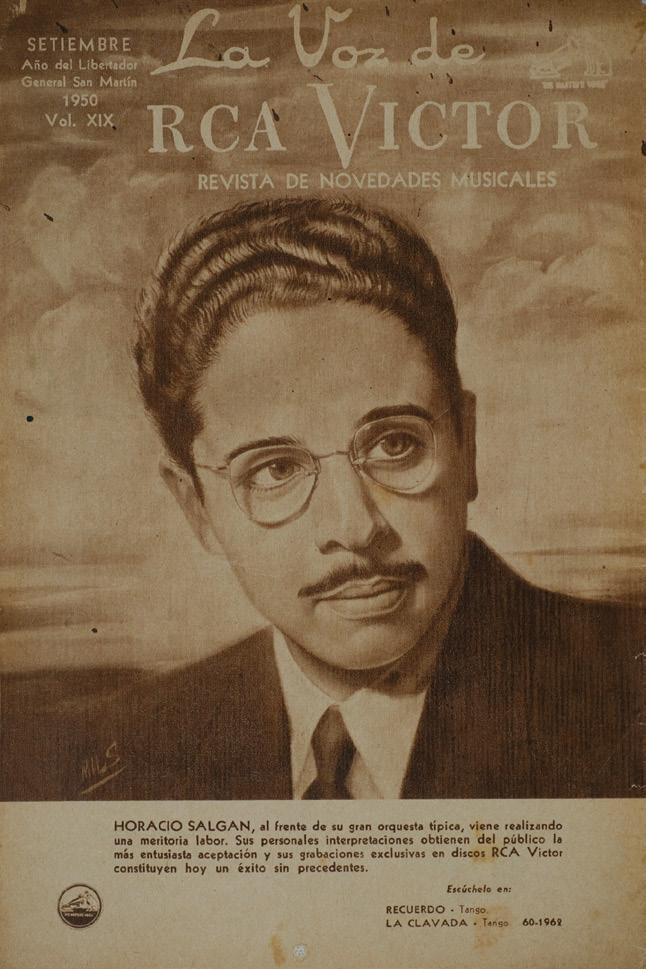
It was in 1950 that Horacio Salgán entered the RCA Victor recording studios, inaugurating the first chapter of his discographic legacy. By then, he was already a seasoned musician. Born in Buenos Aires in 1916, he began as a pianist in cinemas, churches, and radio stations, performing both as soloist and accompanist, with a repertoire ranging from tango to jazz, foxtrots, rumbas, valses, and milongas. During the 1930s and early 1940s he played in the orchestras of Juan Puey, Aldo Martínez-Ledesma, Roberto Firpo, Alberto Cima, and Juan Ryera, experiences that honed his versatility and broadened his musical language.
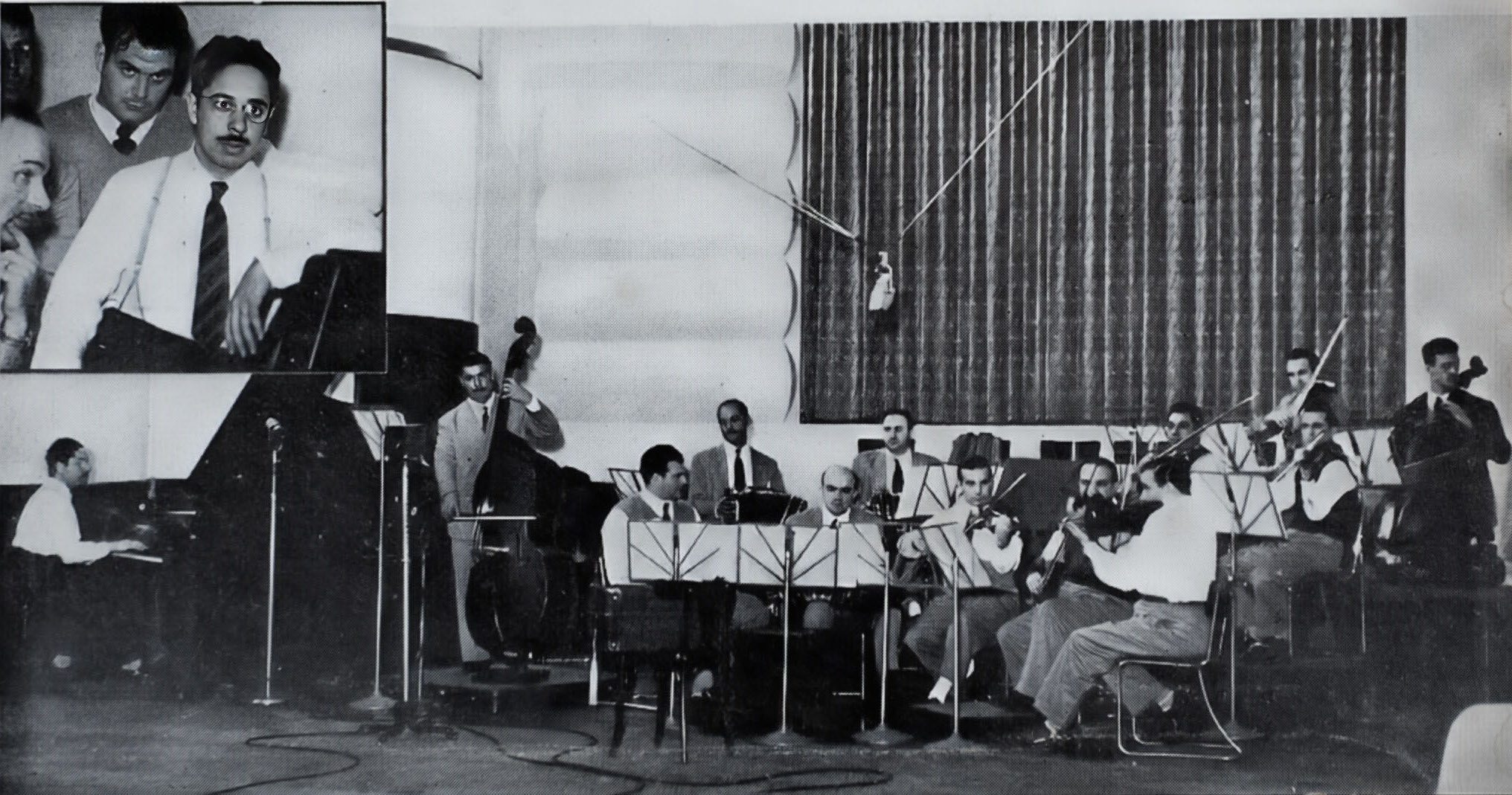
In 1944 Salgán formed his first orchestra, which remained active until 1947. It performed regularly on Radio El Mundo and in clubs and cabarets, with singers such as Lucio Tabares, Carlos Bermúdez, Héctor Insúa, Oscar Serpa, Jorge Durán, and especially Edmundo Rivero, whose professional career took off under Salgán’s direction. This pioneering ensemble left no studio recordings, but it established Salgán’s reputation as an innovator, presenting a repertoire largely built on his own arrangements of traditional tangos and laying the groundwork for what critics later called the era salganiana.
Between 1950 and 1957, his orchestra recorded 56 pieces: 47 tangos, eight valses, and one milonga. Of these, 31 are purely instrumental numbers — an unusually high proportion for the time, reflecting both Salgán’s mastery of orchestration and his conviction that tango could stand powerfully on its own. The singers who joined him in this period, in order of appearance, were Ángel Díaz, Horacio Deval, and Roberto Goyeneche. In 1952, Roberto Goyeneche joined Salgán’s orchestra, replacing Horacio Deval and sharing singer duties with Ángel Díaz. His early recordings with Salgán (for RCA) include «Alma de loca», «Yo soy el mismo», «Un momento» and «Siga el corso». At the close of this cycle, in 1957, Edmundo Rivero returned to collaborate with Salgán on the Antar Telefunken album, bringing his unmistakable voice into one of the orchestra’s most powerful projects.
The orchestra immediately stood out for its unique, universal sound. Built on a solid rhythmic foundation, it combined complex harmonies with unexpected modulations and refined orchestral colors. The arrangements often highlight countermelodies in the bandoneons and violins, weaving a dense yet transparent texture that supports the melody. His piano remained central, both as a rhythmic motor and as a source of improvisatory ideas.
Although avant-garde in conception, the music was never divorced from the dance: the strong pulse in marcato en cuatro is almost always present, yet with Salgán it is constantly modulated, displaced, and contradicted. He plays with off-beats, syncopations, and unexpected accents, and even employs complex devices such as rhythmic cross-patterns or the superposition of ternary and binary divisions. This gave his orchestra a rhythmic elasticity unlike any other.
And Salgán’s search for new timbres extended to the lower register: as he explained in his book «Curso de Tango», he integrated the bass clarinet (clarón) as a permanent member of his orchestra. In the 1957 Antar Telefunken recordings, its warm sonority can be heard blending beautifully with Edmundo Rivero’s deep vocal register.
His RCA contract lasted until September 2, 1953. He then moved to the newly founded Buenos Aires label Disco T.K., where he recorded until around May 1956. T.K. maintained an agreement with Sondor in Montevideo, which published much of its catalogue in parallel — including Troilo’s recordings and those of Salgán. This circulation, together with invitations to perform at Montevideo’s new Club Guardia Nueva, gave him considerable renown in Uruguay and paved the way for his 1957 vinyl release with Antar Telefunken. Among the highlights of this period is his extraordinary rendering of Troilo’s «Responso», a performance of haunting intensity.
As a composer, Salgán enriched the repertoire with a number of important works. Among them are «Motivo de vals», «Don Agustín Bardi», «La llamó silbando», «Del 1 al 5 (Día de pago)», «Grillito», the outstanding «A fuego lento», «Homenaje», and «Entre tango y tango».
The story of «Motivo de vals» illustrates Salgán’s creative process. While arranging Hugo Gutiérrez’s «Llorarás, llorarás», he wrote a countermelody. Poet Carlos Bahr, upon hearing it, remarked: «That is a waltz motif!» Salgán developed the idea into a full-fledged composition, with new lyrics by Bahr. In this way, a secondary line — normally just part of the arranger’s craft — became the seed of an entirely new score. The anecdote also reveals how tango itself takes shape: the written sheet music provides the skeleton, but the true identity of a piece emerges in the orchestra through countermelodies, rhythmic variations, phrasing, and color. Salgán, by elevating one of those fleeting inventions into a work of its own, showed both his compositional brilliance and the living, transformative nature of tango.
This edition also includes a special bonus track: an acetate disc believed to have been recorded live around 1952 in Montevideo at the Club Guardia Nueva. It contains a solo piano performance by Horacio Salgán of «La cachila», an instantaneous recording typical of the time. On the reverse side, pianist Héctor Stamponi plays his own composition «Romance y tango», written in 1952. Although the sound quality of these acetates is not comparable to the studio recordings, they preserve a rare and intimate testimony of two of tango’s most original pianists.
Shortly after this period, Salgán turned toward chamber tango. Around 1959–1960, he launched the Quinteto Real, conceived from the duo he had been performing with Ubaldo De Lío. Salgán proposed expanding it into a group of virtuoso soloists, and the first official lineup included Pedro Laurenz on bandoneón, Enrique Mario Francini on violin, Ubaldo De Lío on guitar, and Rafael Ferro on double bass. After about two years, Kicho Díaz succeeded Ferro on the bass. Designed as an ensemble for listening, the Quinteto Real marked another milestone in Salgán’s career, carrying his vision of tango into a more intimate yet equally sophisticated format.
Pitch
Our restoration work has also shed light on the orchestra’s changing concert pitch during these years. At the start of the 1950s, in Salgán’s first RCA Victor sessions, the orchestra was tuned to the modern standard of A = 440 Hz. From May 1952 onward, however, the pitch rises clearly to A = 442 Hz, the so-called afinación brillante, and remains there until the end of the RCA contract in 1953.
With the move to the label Disco T.K., an unexpected shift occurred: the earliest recordings reveal a regression to A = 435 Hz, a tuning standard from earlier decades. This can be explained by the label’s recording arrangements. In its first phase, Disco T.K. worked at the Emelco studios, but later moved to Radio Splendid, where the in-house piano was most likely still tuned to 435 Hz. The same pitch regression phenomenon can be observed in other Disco T.K. sessions of the period, including those of Aníbal Troilo.
At the end of 1953 or the beginning of 1954, the situation changed: T.K. recordings appear now at 442 Hz, suggesting that the studio upgraded its piano to meet the expectations of the new generation of avant-garde orchestras. From then on, Salgán maintained the bright tuning of 442 until the end of the 1957 Antar Telefunken album. As a side note, the live acetate recording from Uruguay also features a piano tuned to 435 Hz — further evidence of the diversity of tuning practices across venues and recording studios at the time. We have included the pitch information from our analysis in both the comment section of our discography document and the track metadata.
As usual, we have analyzed all recordings on this album individually to determine the precise speed for our transfers, paying particular attention to isolated piano notes. The pitch information is crucial for us—and for you—so that you can enjoy these recordings in their intended tonality and tempo.
Discography
There was never a coordinated discography of Horacio Salgán’s orchestra, so we have built one from scratch. Y ou will find it in the album archive and as a free download on our website. It remains a work in progress: Salgán’s very first 1940s recording (a piano solo) is mentioned but not yet documented in detail, so our discography begins in 1950. Collectors may also notice that some original shellac catalogue numbers are missing, since many surviving copies are later RCA shellac reissues from the 68-0000 series. We hope to fill in these gaps over time.
Phonotechnical notes
A special effort was made to present Salgán’s orchestra with a homogeneous sound across the different recording labels, while always respecting the particular character of each historic session. The preamplification stage remained similar throughout, with one exception: for the 1957 Antar Telefunken LP we applied a specific de-emphasis curve required by that pressing.
The RCA and especially the Disco T.K. records posed significant challenges. Many are affected by off-axis cuts, out-of-round pressings, and surface distortion, causing in particular very strong wow & flutter (noticeable fluctuations in pitch). Wherever possible, these flaws were mitigated mechanically by carefully re-centering the disc on the turntable, or digitally corrected in the transfer stage.
As with our Troilo project, the guiding principle was transparency: to let the textures of Salgán’s music — with its complex harmonies, counter melodies, and rhythmic layers — emerge clearly without being clouded by technical defects. In the most difficult cases, subtle mastering EQ was applied to correct deficiencies in the source medium and to harmonize overall loudness and tonal balance, always with the aim of preserving the original timbre of the orchestra.
Formats
This edition is available in the formats: 24-bit/96kHz FLAC, 16-bit/44.1kHz CD-quality AIFF and FLAC, and 320kbps CBR MP3. All files are sourced from our high-resolution digital master and should sound identical across all formats. The only differences lie in bit depth, sampling rate, and codec. We have consistently applied a 0.5-second fade-in at the beginning of each track and a 1.0-second fade-out at the end, with an additional 3.0 seconds of trailing silence. If a track already has a diminuendo ending, we have reduced the trailing silence accordingly.
Acknowledgements
Age Akkerman, Amsterdam
For the proofreading and harmonic analysis.
Omar Facelli, Montevideo
For his expertise in 78-rpm records, his extensive knowledge and connections within the tango collector community, and for managing our mini studio in Montevideo.
The album